The current printing and packaging industry is undergoing an unprecedented productivity transformation. However, when visiting several printing and packaging factories in the process of transformation, we witnessed a harsh reality: many enterprises invested heavily in building new factories, but still failed to break free from the management core of "handicraft workshops"; the new and old equipment had "language barriers" and data gaps; the number of SKUs for orders skyrocketed, and finding materials in the workshop relied entirely on "shouting", and the production scheduling plans relied entirely on "guessing"; it seemed that the machines were roaring, but the profits were secretly consumed by frequent material shortages, equipment adjustments, machine downtime, and idle materials.
Facing these common pain points in the industry, AIMS proposed a set of solution ideas based on the essence of production and operation: True intelligence is not simply the simple assembly of hardware, but must be achieved through the integrated collaboration of new and old equipment adaptation, MES execution center, LES logistics guarantee, and APS intelligent scheduling, to reshape the "digitalization" skeleton of the factory.
1. Wake-up at the bottom: break through the "last link" of automation between old and new equipment
The intelligent transformation of printing and packaging factories is not usually done on a blank sheet of paper, but rather in the complex existing equipment. AIMS discovered in practice that breaking through the connection at the physical layer is the cornerstone of all digital transformations.
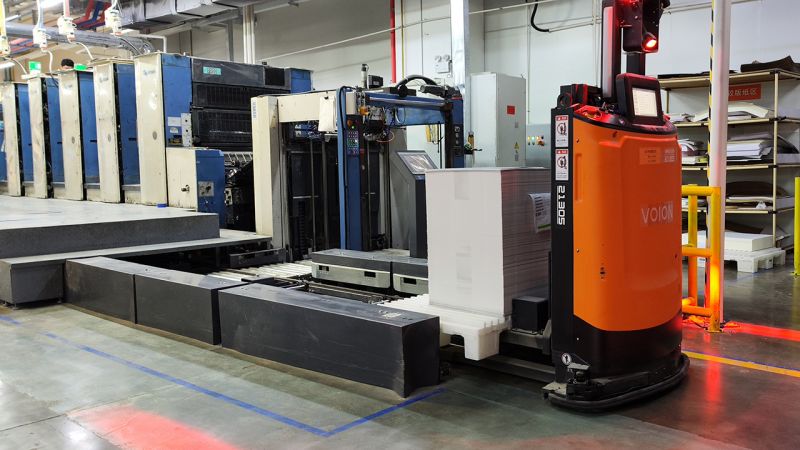
In response to the common "mixing of new and old" problem in the industry, AIMS did not adopt a "one-size-fits-all" elimination strategy. Instead, it carried out customized "digital and intelligent surgery":
For old equipment, such as multi-color offset printing machines, high-speed die-cutting machines, or box-filling machines that have been in service for many years, their mechanical structures are still robust, but they have issues like closed protocols and data gaps. By installing high-precision sensors, intelligent gateways, and conducting deep renovations on the equipment, the underlying protocols are parsed. This not only enables real-time collection of key indicators such as rotational speed, reasons for shutdown, and fault codes, but also gives the old equipment the "communication capability" to participate in intelligent collaboration.
More practically, intelligence also demands "secondary adaptation" for new equipment. In fully automated production lines, due to differences in physical interfaces or heights, it is often impossible to connect with logistics terminals such as AGVs. Taking the equipment loading port as an example, to achieve fully automatic loading, the lifting height of the AGV is precisely "raised" for the machine base, and electrical signals are integrated to complete the connection.
Only through this customized intelligent transformation of new and old equipment can the factory truly establish a unified and closed data foundation, making each piece of equipment a node that resonates in the digital and intelligent network.
2. Process Control:MES builds a paperless hub and reconstructs the logic of production factors
If equipment renovation is to "open up the neural network", then the MES production execution system is the factory's "neural center". In traditional printing and packaging workshops, production instructions rely on paper-based transfer forms, with information lagging and prone to loss, and the matching of human, machine, and materials often remains in a "black box" state.
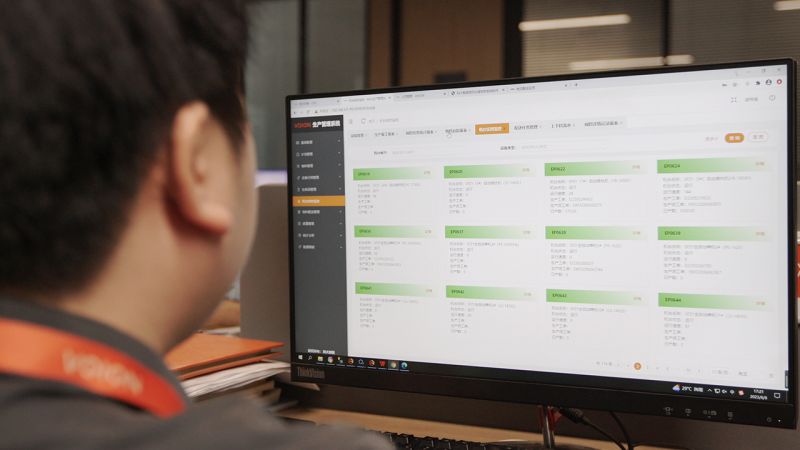
In the solution architecture of AIMS, by introducing the MES production execution system, the aim is to achieve full paperless and data-driven production processes. By deploying intelligent terminals at each workstation, MES has achieved closed-loop control of the five major production factors - "people, machines, materials, methods, and environment". Operators can obtain operation instructions (SOP) and production commands by scanning codes, ensuring zero missing production information.
What is particularly important is that MES records the circulation paths of each piece of paper and each type of raw material on the machine, including waste removal, leftover material management, and machine adjustment optimization. This extremely granular data collection enables managers to have real-time insights into the production progress and bottlenecks, ensuring that any fluctuations in the production site can be captured and warned by the system. Through real-time communication with the underlying equipment, MES tightly integrates the production execution layer and the logistics management layer, transforming the production process from "result traceability" to "process pre-control", completely eliminating the management model based on experience.
3. Supply Assurance
LES Precisely Empowers, Fulfilling the "Four No" Commitment of Material Management
The continuity of packaging and printing production is largely dependent on the stability of material supply. The variety of materials is complex and the specifications are diverse, resulting in logistics management being in a "fire-fighting" state all the time. To address this industry pain point, AIMS uses the LES logistics execution system to solve the timeliness and accuracy issues in material management through digital means, achieving the "Four No" commitment.
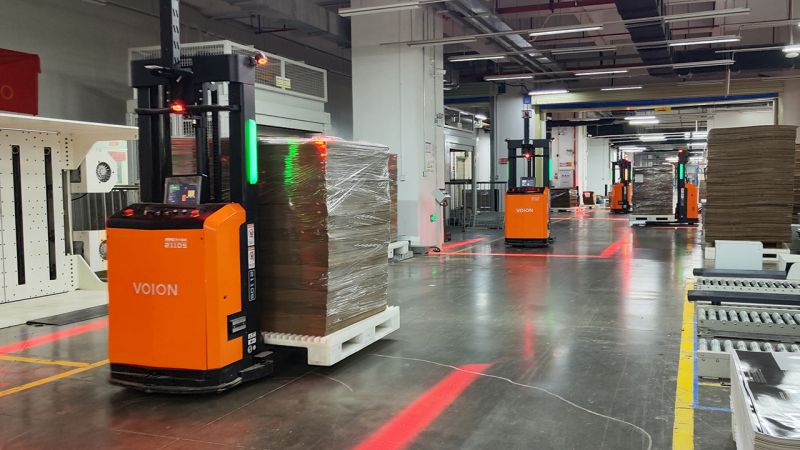
Insufficient Material: Solving the problem of timeliness. LES synchronizes with the MES plan to calculate material requirements in advance, instructs AGVs or manual staff to prepare goods in advance, transforming "waiting for materials while the machine is idle" into "timely delivery".
Insufficient Supply: Solving the problem of overall perspective. The system continuously monitors the positions and inventory quantities of upstream and downstream materials, eliminating information blind spots and ensuring continuous production of long-term orders.
Insufficient Material: Solving the problem of accuracy. By using RFID and barcode technologies for multiple verifications, it completely avoids the frequent occurrence of material batch confusion or specification misuse in manual verification.
Insufficient Delivery: Solving the problem of completeness. Through systematic counting and automatic verification, it ensures that each batch of auxiliary materials and each piece of printing plate can be precisely matched with the work order, leaving no omissions.
In the system of AIMS, LES is no longer merely a dispatcher of transportation tools, but also a supply officer for the production chain, ensuring that the "main artery of production" always maintains efficient pulsation.
4. Decision-making Brain: APS Intelligent Production Scheduling, Defining Agile Delivery with Data
After equipment is connected to the network, production data is digitized, and material transparency is achieved, the factory has "true data" for decision-making. At this point, the intervention of the APS advanced planning and scheduling system becomes a key move for AIMS to help enterprises improve efficiency.
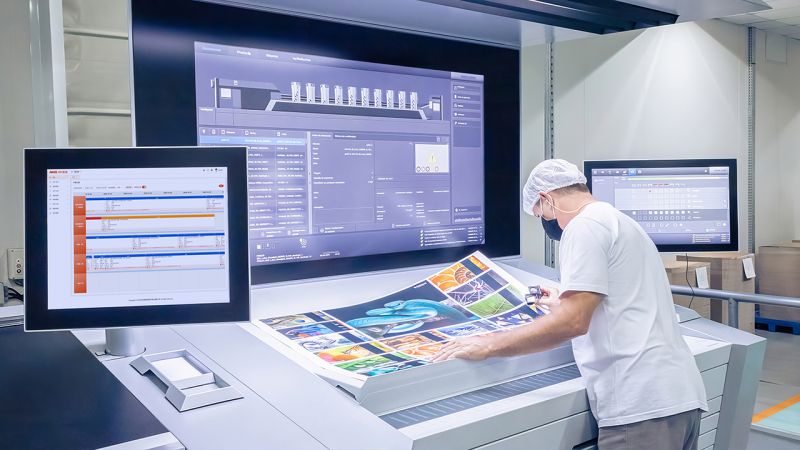
With a large number of SKUs in printing and packaging orders, the delivery cycle is getting shorter and shorter. The APS system aims to optimize the management of order delivery cycles. It is like a conductor with an all-seeing perspective, based on the real-time machine status reported by MES and the real-time material inventory feedback from LES, conducting intelligent simulation scheduling under multiple constraints.
APS can automatically merge similar orders based on the common characteristics of paper specifications, printing color groups, and post-processing processes, minimizing the time for washing machines, changing plates, and adjusting machines. This dynamic scheduling capability, which is precise from "days" to "seconds", enables the factory to have extremely high response flexibility and can fully exploit the equipment capacity while ensuring the delivery time.
The digitalization of the printing and packaging industry is manifested as the replacement of technologies, but its essence is the upgrading of production and operation capabilities.
From the practical path of AIMS, we can easily see that from breaking through the hardware of old and new equipment, to the collaborative dance of MES and LES, to the intelligent coordination of APS, this set of interlocking practical logic ultimately points to the establishment of a more flexible, efficient, and intelligent production and operation system.
When old and new equipment are no longer isolated islands, when materials are no longer a blind spot, and when plans are no longer a game, the operational costs of the factory will naturally be minimized through process optimization. This might be the greatest value that AIMS brings to printing and packaging enterprises. In the era of low profits, truly grasping the initiative in cost, quality, and delivery time.


6F-7F, Building A1, Zhong'an Chuanggu, No. 900 Wangjiang West Road, Shushan District
Postal code:230088
No. 777, Sizhuan Road, Songjiang District
Postal code:201619
Building 1, Yongqi Garden, North Street, Yonglian Town, Nanfeng Town, Zhangjiagang City
Postal code:215600
1st Floor, Building C, Talent Island Technology Industrial Park, Pengjiang District
Postal code:529095
The 9th Tower A, 35th Floor, 33/4, Rama 9 Road, Huai Khwang Sub-District, Huai Khwang, Bangkok, Thailand


Tel