Introduction to the Equipment Monitoring and Predictive Maintenance Business ScenarioPredictive maintenance of equipment involves installing IoT sensors on logistics equipment/production machines and continuously collecting status data during the equipment operation process. By leveraging the equipment maintenance knowledge base at the edge or in the cloud, it manages the maintenance operations and alerts for potential equipment failure risks. This forms a management loop involving the IoT collection end, the edge computing end, and the cloud big data end. The industry value generated by this loop is significant:
1. Regularly maintaining equipment to effectively extend its service life;
2. Alerting for equipment failure risks to ensure production safety;
3. Providing remote fault diagnosis tools, consolidating maintenance experience into the knowledge base, creating value-added services for equipment manufacturers, and guiding third-party maintenance services;
4. Quantifying maintenance operations to provide management basis for third-party maintenance service quality;
5. Utilizing real-time monitoring and data analysis technologies, leveraging edge strategies to promptly handle sudden situations such as site downtime and material shortages.
SCARM is a remote monitoring and maintenance management platform developed by AIMS. Using IoT technology, it monitors the operation status of logistics equipment such as stackers, shuttle vehicles, and elevators in real time. Combined with maintenance operation management data, it calculates equipment failure risks and guides users to take appropriate measures to eliminate equipment failure risks, reducing the risk of equipment downtime due to improper maintenance.
The implementation goals are as follows:
1. Collect and store real-time operation data of equipment such as stackers, shuttle vehicles, and elevators;
2. Real-time display the operation status of equipment such as motors, such as voltage, current, walking speed, abnormal noise, etc.;
3. Predictive maintenance, comprehensively analyzing equipment operation and maintenance operation data to calculate equipment failure risks;
4. Generate regular inspection and maintenance plans, manage maintenance operations, and ensure production safety. two
The business process of the design system
SCARM is a typical IoT application. The data pushed by the edge computing nodes is distributed to the streaming computing module and the log storage module through the message queue. The materialized model is quite different from the model centered on the relational database. After the development team evaluated different IoT development frameworks, they chose TDengine. We will use an example to demonstrate the simple and easy-to-use programming interface of TDengine and how to use it to solve the specific streaming computing problems of IoT. The programming idea of the example is as follows:
1. The collection service collects device data and transmits it to the MQTT Server for data push.
2. The data processing service subscribes to the latest data from the MQTT Server, parses the protocol, processes the specific fields, and writes the data to TDengine using the JDBC standard interface.
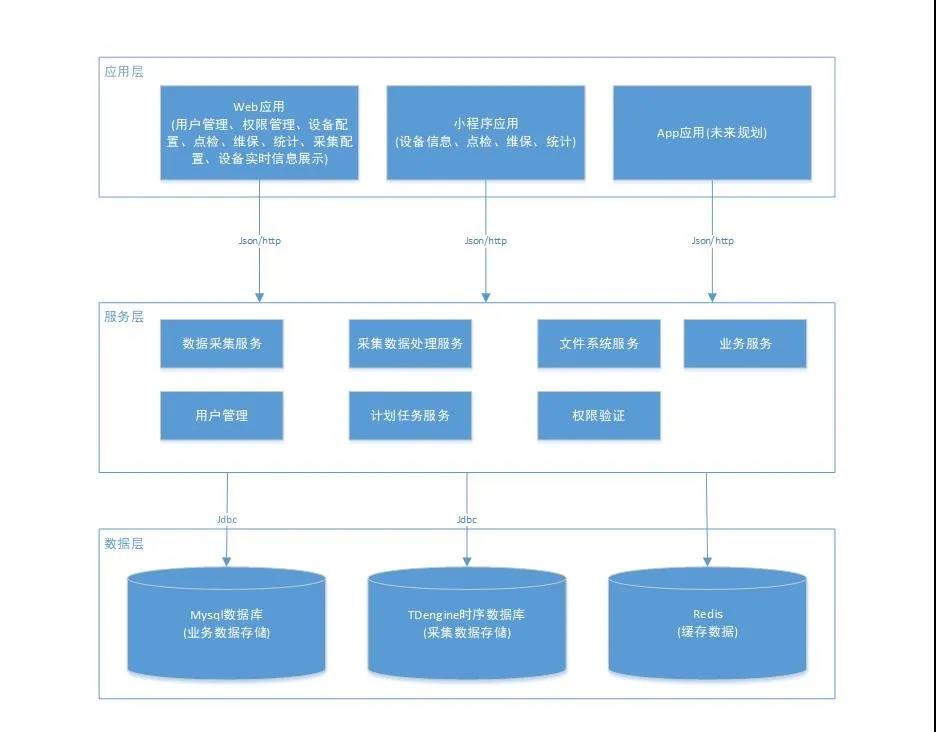
3. The upper architecture is a standard MVC architecture: the application layer calls the service layer to obtain the data from the data layer (TDengine time series database), and returns it for display and operation. Through Grafana, the data layer TDengine database is directly connected, and the real-time data situation of the device is displayed at the application layer.
4. It should be noted that TDengine adopts a design idea of one table per device. Therefore, in the data processing service in step 2, we first build a super table (one super table for each type of device, defining the fields to be collected by this type of device and some static labels such as device ID, grouping, etc.) and the corresponding sub-table for each device in the TDengine time series database. After MQTT protocol parsing, the data of each device should be stored in its corresponding sub-table. The name of the sub-table and the device ID should establish a mapping relationship, so that when writing data, the table name can be directly found based on the device ID information in the reported data. Of course, the business data of the entire platform is still stored in the relational database MySQL; some of the most commonly used data is also placed in Redis. TDengine can solve the caching problem of the latest collected data and eliminate some of the memory overhead of Redis.
The overall architecture of the system is as shown in the following figure: